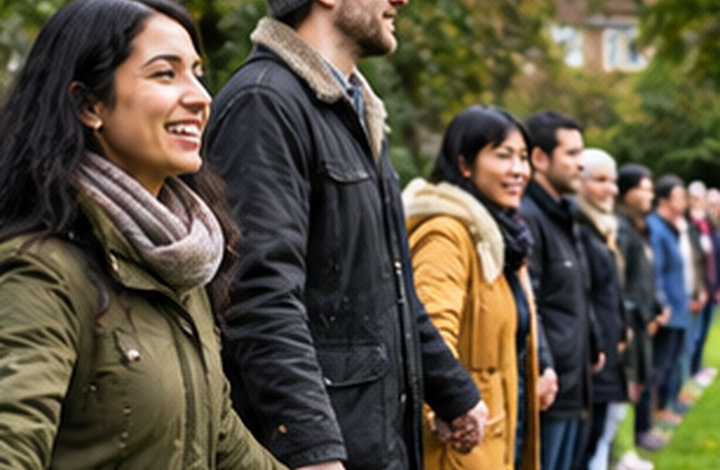
One of the most recognisable invitations during One Day Without Us on 20 February 2017 was remarkably simple: at 1 PM, supporters could gather and link arms. The action did not require a stage, a large budget or a journey to London. It gave people in different workplaces and towns a shared time and an easy way to show that they stood alongside migrants. Contemporary reporting explained that supporters were encouraged to meet in public spaces and make the gesture together.
A small action designed for a national day
National campaigns often face a practical problem: people want to take part but cannot travel, obtain time off or attend a crowded demonstration. A coordinated gesture reduces those barriers. Colleagues can stand outside a workplace, students can gather on a campus, and neighbours can meet in a square. They participate locally while understanding themselves as part of a wider day of action.
For One Day Without Us, the linking-arms moment complemented rather than replaced marches, concerts, assemblies and workplace discussions. It encouraged solidarity without suggesting that all migrants had identical jobs, needs or immigration experiences. The event fitted the campaign’s broader human-chain activities and its invitation to organise in many different ways.
What photographs can—and cannot—tell us
The gesture was designed to be photographed and shared, which helped different communities recognise each other’s participation. Images can document the size and atmosphere of a gathering, a banner’s wording or the people who chose to appear. They cannot, by themselves, establish who organised an event, why every participant came or what happened before or after the photograph.
That distinction matters when recovering material from older websites. A picture of the London rally is a useful record of London in February 2017. It should never be presented as a photograph of a specific event in Bath or Edinburgh without independent evidence. Equally, an online post repeating a campaign hashtag is evidence of communication, not necessarily of physical attendance.
Social media brought the moments together
Research published by the Open University describes how #1DayWithoutUs circulated during the campaign. Social posts helped participants frame their experiences and make acts of solidarity visible to a wider audience. A single hashtag could bring a nurse’s testimony, a student group’s photograph and a musician’s performance into the same public conversation.
Nevertheless, a social-media total is not the same as a count of people at demonstrations. Some accounts post repeatedly, and some people take part without posting at all. Anyone documenting the campaign should label online engagement and in-person attendance separately. This is part of the broader challenge described in talking about migration with evidence and care.
Why a shared gesture can endure
Linking arms has no complicated symbolism: people are physically demonstrating that they stand together. Its simplicity made it accessible to organisers with different resources and encouraged visible participation in many places at once. In that sense, the 1 PM action offers a practical example of how decentralised solidarity works.
The lesson is not that every present-day campaign should repeat a 2017 format. It is that a meaningful collective action can be designed around accessibility, accurate communication and local ownership. When a gesture is easy to understand and safe to join, it can open conversations that continue long after the photograph has been taken. Further examples of the movement’s local activities can be found in the Local Groups overview.