Picture a church hall on a grey Saturday afternoon. There’s an urn of tea, a plate of biscuits going soft and about thirty people who mostly don’t know each other. Some arrived together and huddle by the door. Others came alone and are pretending to read the noticeboard. Someone at the front taps a microphone and says, “Let’s go round and introduce ourselves.” You can feel the room tense up.
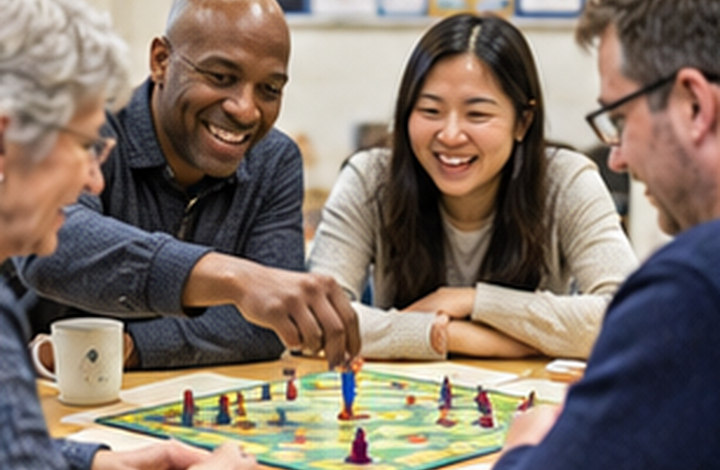
Now picture the same hall with a few tables set out. On one there’s a big jigsaw, half done. On another, a carrom board. On a third, a teenager is showing two older women how a card game works on a tablet. Nobody has been asked to stand up and explain who they are. Within twenty minutes, people are leaning over each other’s shoulders and arguing cheerfully about the rules.
That difference is worth thinking about. A community event doesn’t have to open with a speech or a round of introductions. Sometimes a simple invitation to play does more. A shared activity gives strangers something to look at and talk about that isn’t themselves.
The One Day Without Us campaigns of 2017 and 2018 were political and civic, built around showing the part migrants play in everyday British life. This piece isn’t a claim that the campaign ran any particular games night. It’s a practical look at the kind of activity organisers might borrow when they want a gathering that feels open to everyone.
Doing something together takes the pressure off
Walking into a room of strangers is hard for most people. For someone new to the country, it can be harder still. Where should I stand? Will they understand my accent? Does everyone here already know each other? Those worries can be enough to keep people at home.
A shared task softens all of that. You don’t need to introduce yourself to the room to help find the edge pieces of a jigsaw. You don’t need perfect English to point at a card and laugh when it turns out to be the wrong one. Conversation tends to start on its own once hands are busy.
There’s support for this beyond common sense. The National Lottery Community Fund puts a lot of weight on local activities that build trust and connection between neighbours, which it sets out in its mission on how communities come together. Academic researchers have looked at the same idea. A University of Bristol study on playful infrastructures and social board gaming explores how structured play can make cafes, pubs and community spaces easier to walk into.
It’s worth being realistic, though. No game guarantees friendship. A jigsaw won’t fix loneliness or prejudice on its own. What it can do is lower the first hurdle, and that first hurdle is often the one that stops people coming at all.
Pick games for access, not just for fun
The best games for a mixed gathering are quick to explain. Ideally you can show someone how to play in under a minute, and they can watch a round before deciding whether to join. Anything that needs a ten-page rulebook is probably better saved for a dedicated games club.
Organisers shouldn’t assume everyone can read long instructions in English. Some people won’t want to perform in front of others. Some won’t want to compete against strangers at all. Cooperative games, where everyone works together against the game, can be a good fit for that reason.
Plenty of options work well. Cooperative puzzles. Drawing games, where a picture says more than words. Classic board games that many people already know in some form. And for younger participants, or anyone more at home with a screen, a modernized digital card game on a shared tablet can be a good way in, especially when someone who already knows it does the teaching. These are examples only, not recommendations for any particular commercial product.
Small touches help. A card on each table with simple picture instructions saves a lot of explaining. Volunteers who know the rules can sit in and teach patiently. Nobody should ever be asked to prove how good their English is or how much they know about British culture. And there should always be room for people who’d rather pour the tea, help in the kitchen or simply sit and watch. Watching counts as taking part.
Games carry stories
Games travel with people. A board game played in Lagos may turn up decades later in a flat in Peckham with slightly different rules. Carrom, common across South Asia, has found a home in British community centres. Dominoes slapped down hard on a table is a sound many Caribbean families in Britain grew up with. Backgammon, played as tavla in Turkey and as tavli in Greece, has been argued over in cafes for centuries. Each one carries a little history from wherever it came.
That makes games a natural starting point for conversation. Ask someone what they played as a child and you’ll often hear about a grandparent, a street, a language, a move from one country to another. Sometimes the story turns out to matter far more than who wins.
Care is needed here, though. Nobody should be treated as the spokesperson for a whole country or culture. A good facilitator asks whether someone would like to share a game they enjoy and makes it easy to say no. Participation has to be voluntary.
The same goes for money and privacy. A community event should never pressure anyone into spending money or handing over personal details. The point of the afternoon is connection. It isn’t a transaction.
A gentle way to practise a language
There’s a quieter benefit too. For people still learning English, a game can be one of the least stressful places to practise. ESOL teachers across the UK have used games in class for years for exactly this reason. Naming a colour, counting points out loud or asking “your turn?” is real conversation, but nobody is being tested.
It works the other way round as well. A British volunteer who learns to count to ten in Polish or Urdu because that’s how the scoring goes at their table has just been given a small lesson in what it feels like to be the beginner. That shift in who knows the rules can do more for a sense of equality than any welcome speech.
The trick is to keep it light. Nobody should be corrected in front of the group. A game is there to give people a reason to talk, not a reason to feel embarrassed about how they talk.
Plan an event people can actually get to
A brilliant activity is no use if people can’t reach it. Some of the most important decisions happen long before anyone sets up a table.
Choose a step-free venue wherever possible. Publish clear details in advance about how to get there, what time it starts and ends, whether there’s a cost, what food will be available and what support is on offer. Say whether children are welcome. Mention if there’s a quieter room for anyone who finds noise overwhelming. Age UK’s guide to social groups and activities is a useful reminder of how many older people rely on that kind of practical information before they’ll try something new.
On the day, short demonstrations beat long welcome speeches. Volunteers can greet new arrivals warmly without making them the centre of attention. They can introduce people to each other only when both are happy to be introduced, and make it easy to step back if someone wants to.
Afterwards, ask people what they enjoyed and what made it hard to join in. A few honest answers on a feedback card are worth more than a photo of a packed room.
Keep the connection going
One afternoon is a start. The real measure of a gathering is whether anything grows from it.
Organisers might follow up with a monthly social, a language exchange, a shared meal or a volunteering project. Offering a way to stay in touch makes sense, so long as signing up is clearly optional. Nobody should feel they have to hand over a phone number to belong.
The history of One Day Without Us can be a source of ideas without every event needing a campaign banner. Our pages on local groups and gatherings and the 20 February 2017 day of action show how people across the country found their own ways to take part.
In the end, the idea is a modest one. Set out a welcoming table. Put something on it worth gathering around, whether it’s a puzzle, a pack of cards or just a pot of tea. Then let people find their own way in. That small act of neighbourliness can carry well beyond one afternoon.
For more on the campaign and its legacy, visit the One Day Without Us homepage.
Further reading
- University of Bristol: Playful infrastructures and social board gaming
- The National Lottery Community Fund: Communities come together
- Age UK: Social groups and activities
Learn more about the site’s broader historical purpose on the One Day Without Us homepage.